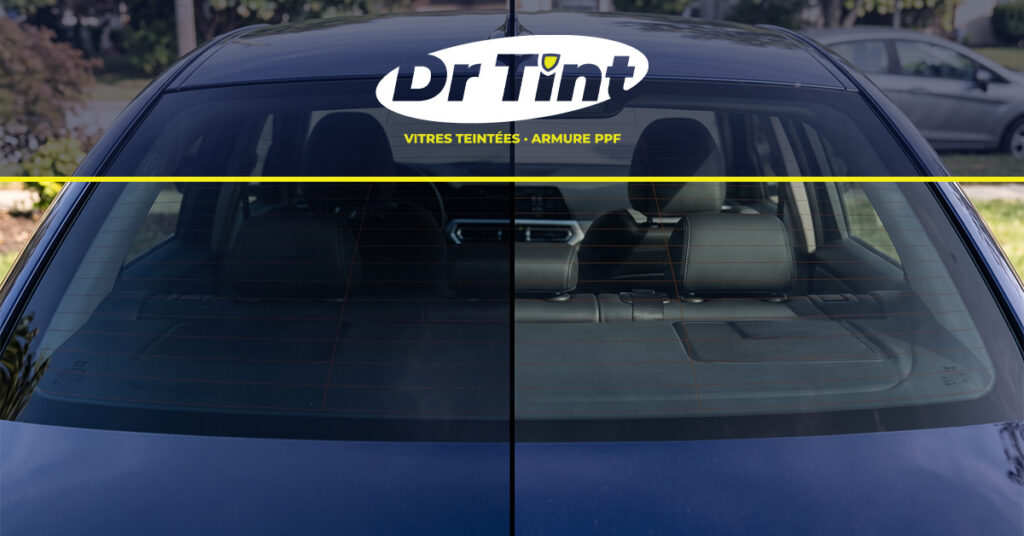
You’ve just taken possession of a newer SUV. The rear windows are already dark, the look is appealing, and you might think there’s nothing more to do. However, factory-tinted windows vs. window tint film are not necessarily the same thing. A dark appearance alone also does not indicate how well the glass performs against heat, UV rays, or glare. Before adding window film, you should therefore consider what is actually installed on the vehicle, the result you want, and, most importantly, the rules that apply in Quebec.
At Dr Tint, we help drivers choose a tint suited to their vehicle and needs, whether they have a newer SUV with factory-darkened rear windows or a car equipped with much clearer glass.
Factory-Tinted Windows vs. Window Tint Film: What’s the Difference?
Factory-tinted glass is part of the vehicle’s original configuration when it leaves the factory. On many vehicles, particularly SUVs and pickup trucks, the rear windows may already appear noticeably darker than the front side windows.
Window tint film is different: it is a film applied to the glass after the vehicle has been manufactured. Automotive window films are available in different visible light transmission levels and with different technologies designed to help manage heat, infrared radiation, UV rays, and glare.
This distinction explains why two windows with a similar appearance do not necessarily offer the same characteristics.
Darker Does Not Automatically Mean Better Performance
This is one of the most important points when comparing factory tint and window film.
The color visible from the outside mainly indicates appearance and how much visible light passes through the glass. It does not accurately determine thermal performance or the ability to filter specific wavelengths.
Window film manufacturers also distinguish between several performance measurements. SunTek, for example, separately identifies visible light transmission, infrared rejection, UV protection, and solar performance. The manufacturer also notes that actual results may vary depending on the type of glass and its properties.
In other words, two vehicles parked side by side may have rear windows that look equally dark without necessarily providing the same characteristics.
Before choosing a window film, it is therefore better to determine what you actually want to achieve:
- change or create a more uniform appearance for the vehicle;
- increase privacy;
- reduce glare;
- obtain certain solar protection properties;
- combine several of these objectives.
Can Window Film Be Added to Windows That Are Already Dark?
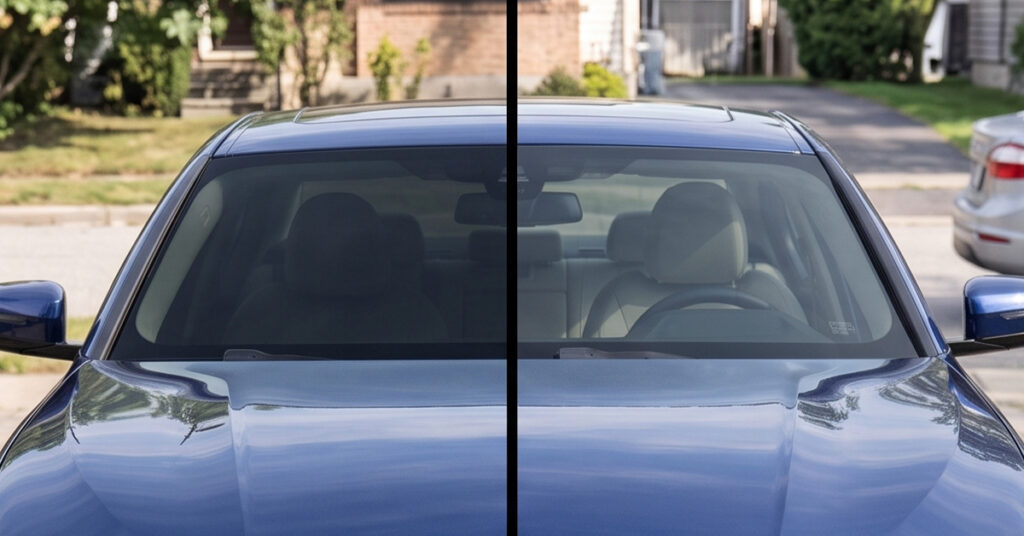
In many cases, window film can be installed on rear glass that already has factory tint. However, the choice should take into account the existing glass and the desired result.
Consider a common example in Montreal. Your SUV already has dark rear windows, and you like its current appearance. You may therefore not want the windows to become significantly darker. Depending on the glass and the products available, a relatively clear window film may be considered when the goal is to obtain certain solar performance characteristics without significantly changing the appearance.
This approach is available, for example, with nearly transparent automotive window films designed to complement factory-tinted glass. SunTek offers a nearly transparent Clear technology intended, among other uses, for this type of application. However, the exact availability of a specific product or product line should be confirmed before installation.
Conversely, if your main goal is appearance or increased privacy, a different tint level may be considered.
The key is not to choose solely based on a photo or a percentage shown on a tint chart.
The Film Percentage Is Not the Final Result of the Window
This distinction becomes especially important for the front side windows.
In Quebec, the windows located on each side of the driver’s position must allow 70% or more of light to pass through when measured with a photometer. This requirement is included in Quebec’s Regulation respecting safety standards for road vehicles.
You should therefore not assume that a film advertised with a certain light transmission level will automatically produce that same result once installed.
The SAAQ points out that factory windows already have a certain level of tint, which must be taken into account when additional film is installed. It gives the example of front side windows that allow approximately 75% of light to pass through: even the addition of a transparent film can reduce light transmission enough to reach the regulatory limit.
It is therefore the combination of the glass and anything added to it that must comply with the standard, not simply the commercial rating shown for the window film.
What Rules Apply to Other Windows in Quebec?
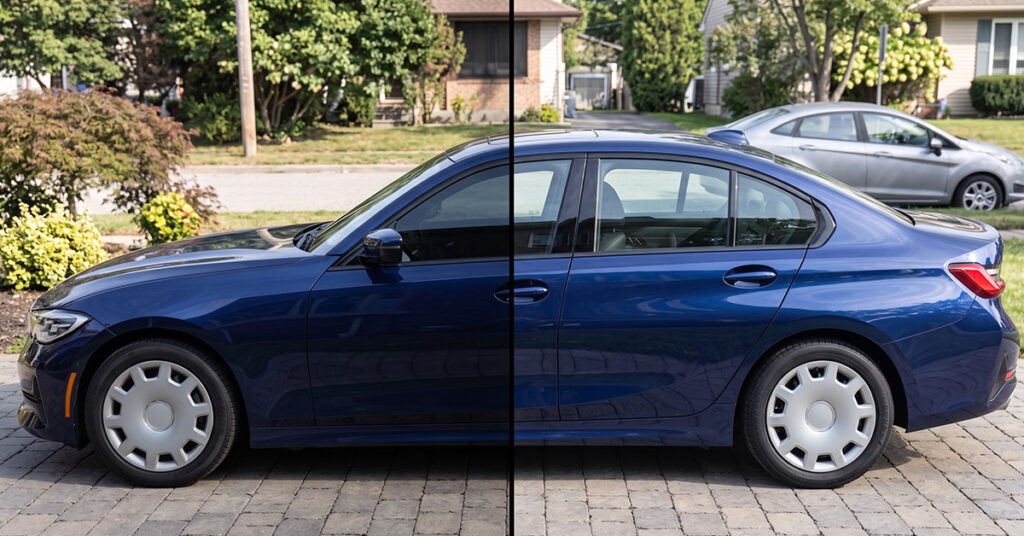
The requirements differ depending on the location of the windows on the vehicle.
For the front side windows, light transmission must be at least 70%.
For the windshield, no darkening or opaque material may be applied or sprayed onto the glass. However, a strip no more than 15 cm wide may be placed along the top portion of the windshield.
Rear side windows and the rear window are not subject to the 70% minimum light transmission requirement that applies to front side windows. The regulations also prohibit applying or spraying any mirror-like material onto a window.
These differences explain why it can be risky to choose exactly the same tint for every window without considering its location on the vehicle.
Why Is a Professional Evaluation Useful?
It is difficult to determine the exact light transmission of a window simply by looking at it. A window that appears relatively clear may already be close to the legal limit applicable to front windows.
The SAAQ also specifies that compliance for front side windows is assessed using a photometer. A simple visual assessment therefore cannot determine the actual percentage of visible light transmission.
Before installation, it is important to consider:
- the glass already installed on the vehicle;
- the windows on which film will be installed;
- the desired tint level;
- the performance characteristics you are looking for;
- Quebec regulatory requirements.
This approach allows you to choose based on the actual vehicle rather than on appearance alone.
Dr Tint in Montreal: Compare Your Options Before Choosing
At Dr Tint in Montreal, we offer several tint levels so the result can be adapted to each vehicle. Our simulator allows you to preview options including Clear, 70%, 50%, 35%, 20%, and 5% on the front side windows, rear side windows, and rear window. We also offer XPEL and SunTek automotive solar window films.
The simulator is a useful starting point for comparing the appearance of different options. However, it does not replace verification of regulatory compliance for front windows, since the actual result also depends on the glass to which the film is applied.
Does your SUV already have dark rear windows? Does your new vehicle seem too light in the front? Are you mainly looking for greater comfort or a more uniform appearance? Visit us or contact Dr Tint in Montreal. We can provide information about the available options based on your vehicle and the result you are looking for.
FAQ About Factory-Tinted Windows vs. Window Tint Film
1. Is Factory-Tinted Glass the Same as Window Tint Film?
No. Factory tint is part of the glass the vehicle is manufactured with, while window tint film is a film applied to the glass after manufacturing.
2. Can Window Film Be Added to a Rear Window That Is Already Dark?
In many cases, yes. However, the product should be selected based on the existing glass, the desired appearance, and the performance characteristics you are looking for.
3. Does Darker Glass Automatically Provide Better Protection Against Heat and UV Rays?
No. Dark appearance and solar performance are separate characteristics. Performance varies depending on factors including the glass itself and the window film technology.
4. What Light Transmission Is Required for Front Windows in Quebec?
The side windows located on each side of the driver’s position must allow at least 70% of light to pass through when measured with a photometer. Both the factory glass and any material added to it must be taken into account.
5. Can Rear Windows Be Darker Than Front Windows?
Yes. In Quebec, rear side windows and the rear window are not subject to the 70% minimum light transmission requirement that applies to the front side windows. However, all other applicable vehicle regulations must still be followed.